Insights: “Soils are silent, but youth– Femi Adekoya, World Food Forum Nigeria”
Beneath the concrete, beneath the parks, and beneath our very feet lies the silent, vital foundation of our urban future: soil. On December 5th, 2025, this unassuming resource took center stage as youth leaders, scientists, and advocates from across Nigeria and beyond convened virtually for a powerful World Soil Day webinar. The message was unified and urgent: Healthy soils are non-negotiable for building healthy, resilient, and sustainable cities.
Event at a Glance
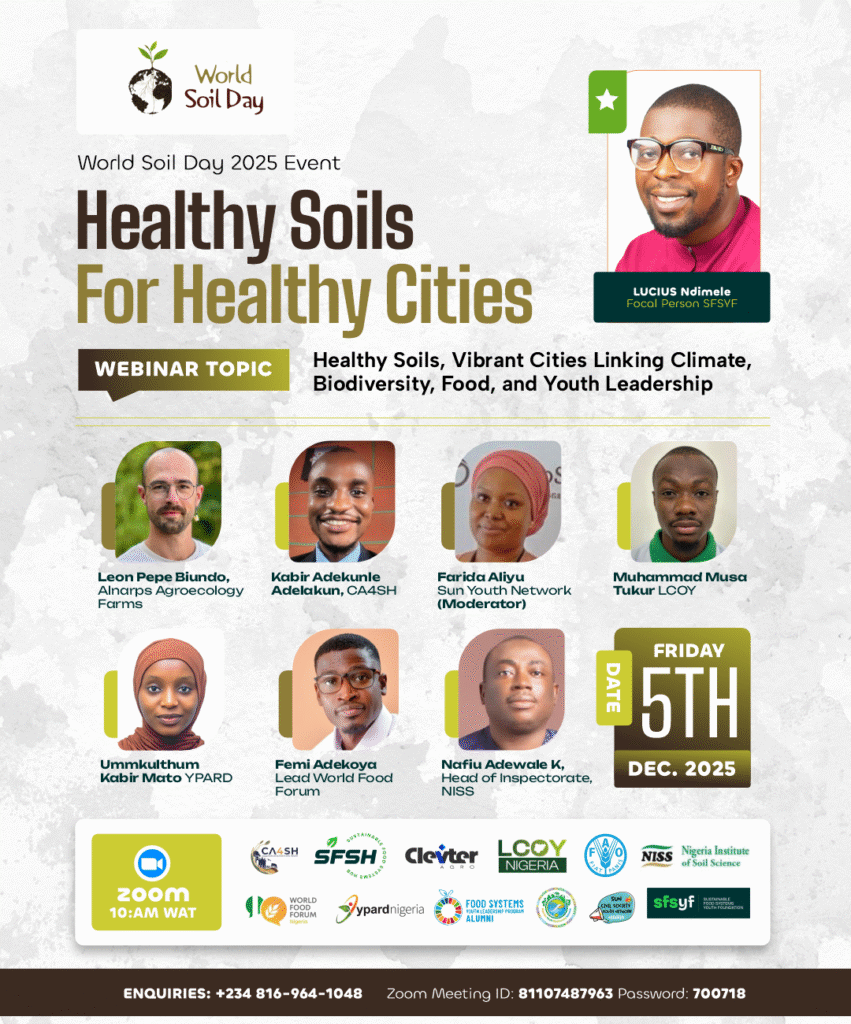
Theme: Healthy Soils for Healthy Cities
Date: December 5, 2025
Host: Sustainable Food Systems Youth Foundation (SFSYF) ·
Co-Organizers: LCOY Nigeria, Nigeria Institute of Soil Science, YPARD Nigeria, World Food Forum Nigeria, Nigerian Youth Biodiversity Network, Scaling Up Nutrition Youth Network, Sustainable Food Systems Hub, & CA4SH
The meeting opened with Ms Farida Aliyu, representing the Sun Youth Network Nigeria, welcoming participants to a webinar on soil health, climate resilience, and urban sustainability, organized by various youth networks and institutions.
Lucius Ndimele, UN Food Systems YLP Alumnus and focal person of Sustainable Food Systems Youth Foundation set the tone with a powerful reminder: soil health is inextricably linked to environmental balance, biodiversity, food security, and even national economic stability. It’s not just about agriculture; it’s about the very foundation of our collective future.
Ummkulthum Kabir Mato, the YPARD Regional Representative for Northwest, discussed the importance of soil stewardship in strengthening urban food systems. She highlighted that soil is a living ecosystem crucial for food production, and urban areas heavily rely on rural food systems but are increasingly producing their own food through urban farming. The challenges in urban soil health include soil contamination, low organic matter, poor water retention, and over reliance on inorganic fertilizers.
To address these issues, Ummkulthum suggested improving productivity in small spaces, implementing waste-to-soil cycles through composting, increasing climate resilience, and ensuring safer food production by soil testing. She emphasized the need for awareness and education to protect soil health and build healthier cities, stronger food systems, and a more climate-resilient future.
Dr. Nafiu Adewale of the Nigeria Institute of Soil Science presented on the Nigerian Farmer Soil Health Scheme, explaining soil health concepts, challenges, and sustainable management practices. He detailed the scheme’s implementation, including soil testing, data-driven recommendations, and the establishment of 774 soil laboratories across the federation. The program aims to increase crop yields, improve fertilizer use, and enhance food security while providing employment opportunities for youth and promoting sustainable farming practices. He also spoke on the Nigerian Soil Information System, which provides digital soil maps and fertilizer recommendations through a centralized repository.
He explained that 11 states have been uploaded to the system, and detailed the roles of various stakeholders including federal government, NGOs, research institutions, and development partners in implementing the soil testing and fertilizer management scheme. The presentation concluded with opportunities for youth involvement in soil sampling, operating laboratories, providing advisory services, and contributing to digital innovation and agribusiness entrepreneurship.
Kabir Adekunle Adelakun of Nigerian Youth Biodiversity Network, delivered a presentation on urban soil biodiversity and its importance for ecological resilience, highlighting how soil organisms contribute to ecosystem functioning through nutrient cycling, water regulation, and carbon storage. He explained that urban soil biodiversity affects air quality and climate resilience by supporting vegetation that filters pollutants and helps moderate urban temperatures.
Kabir emphasized the threats to urban soil biodiversity from rapid urbanization and pollution, and proposed solutions including urban planning approaches, green corridors, community gardens, and nature-based solutions, while stressing the importance of conservation education and policy support.
Leon Biundo of Alnapps Farms and CA4SH presented on his work as production manager at the Alnapps agroecology Farm in southern Sweden, a small-scale organic farm that started in spring 2022. He explained their approach to soil health, which includes minimizing soil disturbance, maximizing biodiversity, and maintaining permanent soil cover through methods like compost mulching and living roots.
The farm, which is half a hectare in size, produces 40 different crops and perennials per season and serves as an educational hub for 250 volunteers, most of whom are students. They use community-supported agriculture to connect people directly with farmers and supply restaurants and markets.
Muhammad Tukur Musa, a young professional at the International Fertilizer Development Center, presented on soil health improvement initiatives in Nigeria, highlighting the Soil Values Program’s work in four West African countries. He discussed the program’s focus on soil fertility management and water conservation practices, particularly in the Sahel region, and shared examples of successful farmer training in composting and soil conservation techniques.
The session concluded with closing remarks by Femi Adekoya (The flying farmer) of the World Food Forum Nigeria chapter, He moved beyond awareness to action, stating that we must learn to teach about the soil and advocate for the soil. His message was clear: the stewardship of this critical resource cannot be silent. Youth must lead the conversation and the action.
The Future is Underfoot, this year’s World Soil Day celebration proved that the movement for sustainable cities is youth-led, grounded in science, and rooted in the soil. The passion and knowledge showcased are paving the way for tangible change.
You cannot have a healthy city without healthy soil so what can you do?
- Educate Yourself & Others: Talk about soil health beyond farming—it’s an urban and
climate issue. - Support Local Soil Stewards: Engage with or support urban agriculture projects in your
city. - Advocate: Champion policies that protect green spaces, reduce pollution, and integrate
soil health into urban planning.
“To love the future is to love the soil. And together, we must continue to protect it every single
day.”
Let’s keep the conversation growing. Follow the host and co-organizers to join the next wave of action.