By Lucius Chimezie Ndimele,
Founder & Executive Director, Sustainable Food Systems Youth Foundation (SFSYF)
National Programme Director, Learn to Impact.
3 July 2026 | 8 mins. read
Nigeria’s future will be shaped not only by the food it produces, but by the young people who will lead the transformation of its agrifood systems.
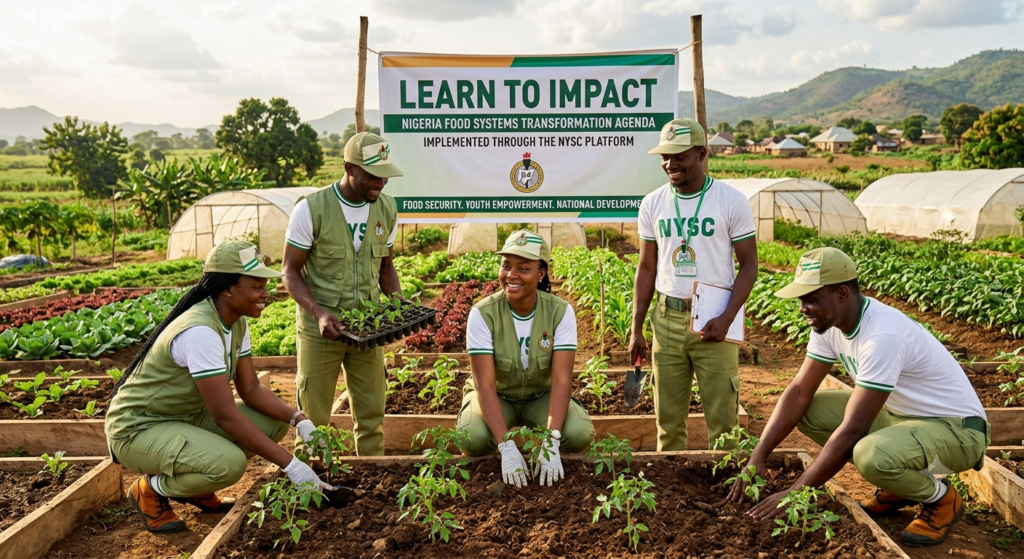
Every year, more than 400,000 graduates are deployed across Nigeria through the National Youth Service Corps (NYSC), serving in communities that reflect the country’s diverse agricultural landscapes, environmental conditions, nutritional challenges, and development priorities. This unparalleled national platform presents a unique opportunity to mobilize youth as catalysts for sustainable food systems transformation.
Learn to Impact was established to seize that opportunity. Learn to Impact is a national youth food systems leadership and implementation programme designed to equip NYSC corps members with the knowledge, competencies, and practical experience required to contribute to Nigeria’s food systems transformation. It combines digital learning, systems thinking, foresight, leadership development, and community-based implementation to empower young people to move beyond awareness and become architects of sustainable change.
The programme has received the endorsement of the Federal Ministry of Youth Development as an innovative contribution to youth capacity development through the NYSC platform. It is co-created by the Nigerian chapters of the SUN Youth Network, Global Youth Biodiversity Network (GYBN), World Food Forum (WFF), and the Local Conference of Youth (LCOY), bringing together expertise in nutrition, biodiversity, agrifood systems, climate action, and youth engagement. The initiative is also being championed by the National Task Team on Food Systems Transformation, domiciled within the Federal Ministry of Budget and Economic Planning, further strengthening its alignment with Nigeria’s National Pathway for Food Systems Transformation.
Beyond Agriculture: A Food Systems Approach
Traditional agricultural programmes often focus on increasing production. Learn to Impact takes a broader perspective by recognizing that agriculture is only one component of a much larger food system.
Food systems encompass everything from soil health, seed systems, farming, fisheries, processing, storage, transportation, markets, nutrition, consumer behaviour, waste management, biodiversity, climate resilience, finance, technology, governance, and policy. These components are interconnected, meaning that interventions in one area often influence many others.
Through this interdisciplinary approach, participants learn to understand complexity, identify relationships, and design integrated solutions that generate economic, environmental, and social benefits simultaneously.
Systems Thinking: Solving Root Causes, Not Symptoms
At the heart of Learn to Impact is systems thinking.
Rather than encouraging young people to address isolated problems, the programme equips them to understand the underlying structures and relationships that create those problems.
Participants learn to map local food systems, identify key stakeholders, analyse feedback loops, recognize leverage points, and design interventions that address root causes rather than symptoms. Whether tackling post-harvest losses, youth unemployment, soil degradation, food waste, poor nutrition, or climate vulnerability, participants are trained to think holistically and collaboratively.
This systems perspective prepares corps members to become adaptive leaders capable of working across disciplines, institutions, and sectors.
Foresight: Preparing Youth for the Future of Food
The future of food systems will be shaped by rapid technological change, climate variability, demographic shifts, evolving consumer preferences, emerging policies, and global market dynamics.
Recognizing this reality, Learn to Impact integrates strategic foresight into its learning experience.
Participants are encouraged to explore future scenarios, identify emerging trends, anticipate risks, and discover opportunities for innovation. By developing futures literacy alongside technical knowledge, corps members become proactive leaders capable of preparing communities for tomorrow’s challenges rather than simply responding to today’s problems.
Learn for SAED. Impact through CDS.
Learn to Impact is intentionally designed around the two pillars of the NYSC service year.
The Learn component aligns with the Skills Acquisition and Entrepreneurship Development (SAED) programme, where corps members participate in a structured online learning journey covering food systems, systems thinking, climate resilience, biodiversity, nutrition, entrepreneurship, leadership, innovation, environmental sustainability, science, technology, and policy.
Learning, however, is only the beginning.
The Impact component is implemented through the Community Development Service (CDS) platform, where corps members translate knowledge into action by designing and implementing practical interventions within their host communities.
This “Learn for SAED, Impact through CDS” model transforms learning into measurable community outcomes. Corps members become active contributors to local development by organizing food systems dialogues, conducting community assessments, promoting climate-smart agriculture, supporting nutrition initiatives, reducing post-harvest losses, restoring ecosystems, strengthening value chains, and implementing locally relevant innovations.
The result is a service year where learning and community service reinforce one another, creating lasting benefits for both participants and communities.
Building the Science–Policy–Society Interface
Learn to Impact embraces the Science–Policy–Society Interface (SPSI) by creating meaningful connections between research, policy, and community action.
The programme encourages collaboration among universities, research institutes, government ministries, development partners, private sector organizations, civil society, and local communities. Through dialogue, evidence generation, and collaborative implementation, corps members become knowledge brokers who help translate scientific knowledge into practical solutions and provide valuable grassroots insights to inform policy.
This approach strengthens the relationship between science, policy, and society while ensuring that youth remain central to national food systems transformation.
A Collaborative National Platform
As the flagship programme of the Sustainable Food Systems Youth Foundation (SFSYF), Learn to Impact is built on collaboration rather than duplication.
The programme brings together youth networks, government institutions, academia, development partners, and the private sector, with each partner contributing its comparative advantage while working towards a shared vision of resilient, inclusive, and sustainable food systems.
Together, these partnerships create an ecosystem where leadership, innovation, knowledge sharing, policy engagement, and community action reinforce one another.
Investing in the Leaders Nigeria Needs
Nigeria’s food systems cannot be transformed by technology alone. They require leaders who understand complexity, embrace collaboration, anticipate the future, and possess the skills to turn ideas into measurable impact.
Learn to Impact is investing in those leaders. By combining systems thinking, strategic foresight, interdisciplinary learning, practical implementation, and national collaboration through the NYSC platform, Learn to Impact is helping build a generation of young Nigerians capable of transforming food systems from the community level to the national stage.
The future of Nigeria’s food systems will not simply be inherited, it will be designed, implemented, and sustained by young leaders equipped to learn, to lead, and above all, to create lasting impact.